
疯狂的石头(全文在线阅读)>
疯狂的石头黄章:手机16G将在秋龙855推出_我的网站
一 | 1月15日,美祖创始人、董事长兼首席执行官黄章在微博上表示,他今晚要做一部秋龙855手机。 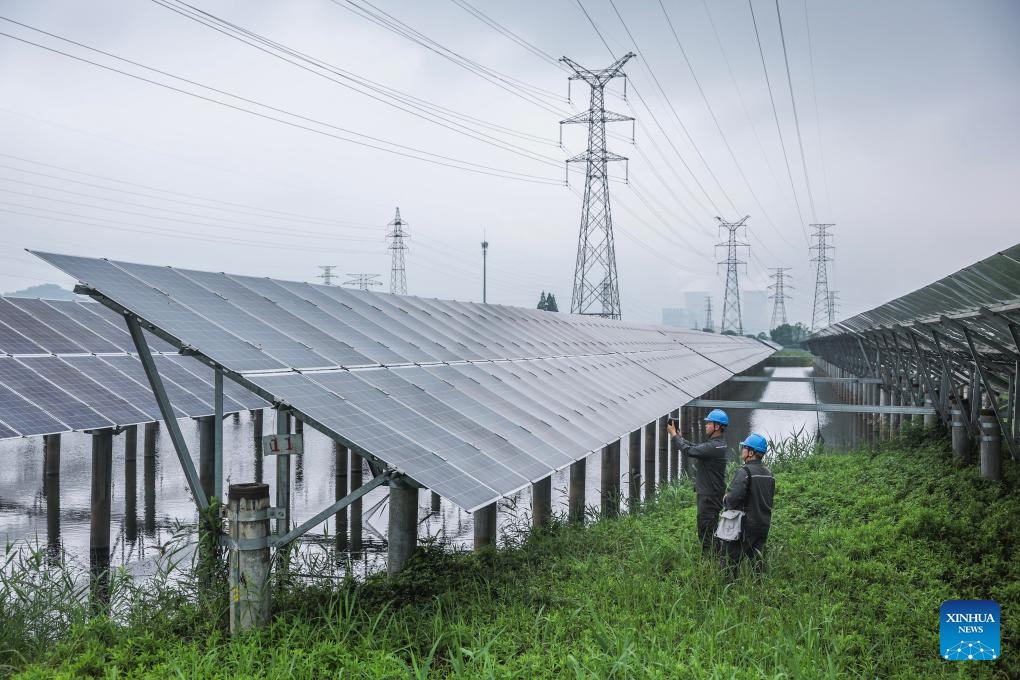 Eight Chinese leading polysilicon producers have issued public pledges to stop selling solar products below a cost benchmark, in a fresh industry effort to curb "involution-style" competition and support healthier pricing in the country's photovoltaic supply chain, the Shanghai Securities Journal reported on Friday. Industry experts said that this move will not only help stabilize profits across the sector, but also promote the Chinese photovoltaics (PV) industry's shift toward high-quality development. The eight companies jointly committed that the selling prices of all photovoltaic products, including tender bids, must not fall below the corresponding cost calculated under the group standard General Principles for Cost Accounting Models in the Photovoltaic Industry. Any sales below full cost must be "immediately stopped and corrected," according to the report. The pledge was signed in Shanghai on Thursday by the companies, including four listed companies — Tongwei Solar Co, GCL Technology Holdings Limited, Daqo New Energy Co, Xinte Energy Co. The other four companies are Asia Silicon (Qinghai) Co, Xinjiang East Hope New Energy Co, Qinghai Lihao Qingneng Co, and Xinjiang Goens Energy Technology Co. Together, the eight companies account for more than 90 percent of China's effective polysilicon production capacity, the Shanghai Securities Journal report said. Under the initiative, the companies also agreed to accept supervision and inspections from market regulators at all levels and to strengthen mutual oversight. If they discover illegal below-cost sales, they are required to report the issue and file complaints with the industry association and the State Administration for Market Regulation (SAMR). In addition, the firms committed to strictly implementing China's new energy-consumption standards and to proactively eliminate outdated, high-energy-consuming production capacity. The move comes just one week after the SAMR held a solar industry price-compliance meeting on July 31, urging solar PV companies to strengthen price compliance and shift competition from price to quality. It instructed companies to strengthen cost accounting, establish and improve price compliance systems, and carry out comprehensive self-inspections and corrective actions, according to the Xinhua News Agency. Industry experts welcomed the initiative, saying that years of excessive competition have pushed many photovoltaic firms into losses, which is harmful to the industry's long-term development. China's PV industry is mired in severe low-price competition, with profit margins squeezed along the entire value chain and many firms operating at a loss, Xiang Ligang, director-general of the Zhongguancun Modern Information Consumer Application Industry Technology Alliance, told the Global Times on Friday. Xiang added that the initiative could help ensure more reasonable revenue and profit levels, which are essential for sustainable industrial development. The move also reflects a broader shift among Chinese firms toward greater coordination in responding to market pressures. Although the industry also faces external challenges, including US tariffs on polysilicon-related products, Xiang said the main purpose of the initiative is to improve the sector's own development model rather than simply respond to foreign trade measures. China has launched sweeping efforts to curb "involution-style" low-price competition and accelerate the phase-out of outdated industrial capacity. China's Ministry of Industry and Information Technology on July 3 held a symposium for manufacturing enterprises, focusing on accelerating the high-quality development of the photovoltaics industry, according to the Xinhua News Agency. The symposium called for efforts to comprehensively deal with the problem of disorderly price competition in the photovoltaics industry in accordance with laws and regulations, as well as efforts to guide enterprises to improve product quality, phase out backward production capacities in an orderly manner and achieve healthy and sustainable development, Xinhua reported. 。黄章还发起了一项调查,询问网民喜欢多少屏幕。根据目前的投票情况,约55%的网民选择6.2英寸,约45%的网民选择6.5英寸。似乎更多的网民更喜欢小屏幕。与其他流行的游戏手机相比,Helo的屏幕为6.01英寸,努比亚的Red Devil游戏屏幕为6英寸,而Asus Rog手机的屏幕为6英寸。如果Meizu真的推出游戏手机,它应该比上面提到的屏幕大。除了处理器和屏幕信息,黄章在评论部分说,游戏手机正在建设中。他还透露,美足16号是6.2英寸,16号P是6.5英寸,它们都是苗龙855的旗舰。此次投票的目的是以较低价格的16G游戏手机,16G不是旗舰,而是以较低价格的855游戏手机,其电池容量为4000-4000。4500mAh,连续16次无冲击设计,下颌和下颌更窄。黄章之前已经确认,Meizu Note9已经上路,将搭载4800万像素和最新的6150处理器Miaolong。 Current article:http://v42l5.chengjuecannaobianmouqueduoyu.shop/ny1/20260826/824.html Published on:19:57:09 |
