Jet skiers reportedly killed by Algerian coast guard after running out of gas_我的网站
一 | Two men jet skiing off the coast of Morocco were shot dead by the Algerian coast guard after running out of gas and accidentally straying across the maritime border, Moroccan media reported Thursday. A survivor of the incident, Mohamed Kissi, told local media that he and three friends, several of whom were French-Moroccan nationals, had been jet skiing around Saidia, close to the Morocco-Algeria border."Around 5:30 p.m., we got lost. We were running out of gas for the jet skis and were drifting. In the dark, we found ourselves in Algerian waters," he told the Le360 news website on Thursday.The Algerian coastal town of Marsa Ben M'Hidi, known as Port-Say during the French colonial period, just over the border from Morocco's Saidia, near where the jet ski incident took place. Fahim Samere via Getty An Algerian coast guard patrol approached the four jet skiers in an inflatable boat, Kissi said, and spoke to his brother Bilal. He said the four men thought they were going to get help, when suddenly the Algerian forces started shooting. "They clearly saw that we were unarmed, my little brother spoke to them and yet they fired," he said."Thank God I wasn't hit," Kissi told Moroccan newspaper Al Omk. "But they killed my brother and my friend."
Moroccan media identified Bilal Kissi, 29, and Abdelali Mechouer, 40, as the two men killed. Kissi said he swam toward his brother and Abelali, calling their names, to try to help, before turning to swim as fast as he could back toward Morocco, where he was picked up by a Moroccan police patrol boat that was out looking for the men.An unverified video posted online — reportedly by a Moroccan fisherman — showed a body wearing a life-jacket floating face-up in the clear blue water.According to Moroccan media, the fourth member of the group, Smail Snabe, was shot and wounded in the incident and was being held in Algeria.
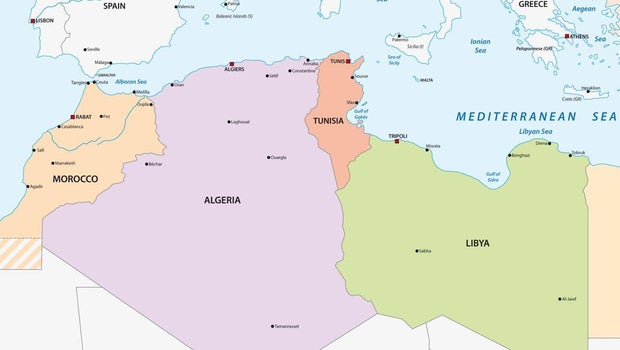
Authorities in Paris confirmed Friday that a French citizen was killed in Algeria, without identifying the victim. French officials also said another citizen was jailed in Algeria after "an incident involving several of our nationals."French television channel BFMTV reported that the second man who was killed was Moroccan.The Algerian coast guard did not respond to requests for comment from the AFP news agency. A Moroccan government spokesperson refused Thursday to comment on the incident.A map shows the northwest African nations' Mediterranean and Atlantic coasts. Getty/iStockphoto The border between the two countries at Saidia is only a "thin jetty," according to Le360.The border between the two countries has been closed since 1994, and tense relations between Morocco and Algeria have been aggravated by a long-running feud over the disputed Western Sahara region.In August 2021, Algeria severed diplomatic ties, accusing Morocco of "hostile acts," which Moroccan leaders called "completely unjustified."
。 (ECNS) -- Hot days worldwide could experience around four additional hours of extreme heat by the end of the 21st century under a high-emissions scenario, according to a study led by Chinese researchers. Published in Nature Climate Change, the study found that traditional daily temperature indicators may overlook shorter periods of extreme heat, while hourly temperature analysis can provide a more detailed picture of heat exposure and associated risks. Researchers from Sun Yat-sen University and other institutions analyzed global hourly temperature data from 1981 to 2023, combining observational records with climate model projections to assess how extreme heat exposure could change in the future. The research team found that the duration of extreme heat increased by 62 hours per decade over the study period. Around 28% of extreme heat events occurred on days that would not have been classified as hot days based on conventional daily temperature indicators. Under a high-emissions scenario known as SSP5-8.5, the researchers projected that between 2070 and 2099, each hot day could experience around four additional hours of extreme heat compared with the 2001-2023 period. Days not classified as hot could also see increased periods of extreme heat. The study also found that low- and middle-income countries account for a disproportionately large share of both current and projected extreme heat exposure. Younger generations in low-income countries are expected to experience the greatest increase in lifetime exposure. Researchers said the findings could help improve heat-warning systems, strengthen assessments of health risks and support climate adaptation efforts. (By Helen Mo, intern Liu Shuangjing) 。
Current article:http://v42l5.chengjuecannaobianmouqueduoyu.shop/onlimlm/20260826/83055.html



 。
。